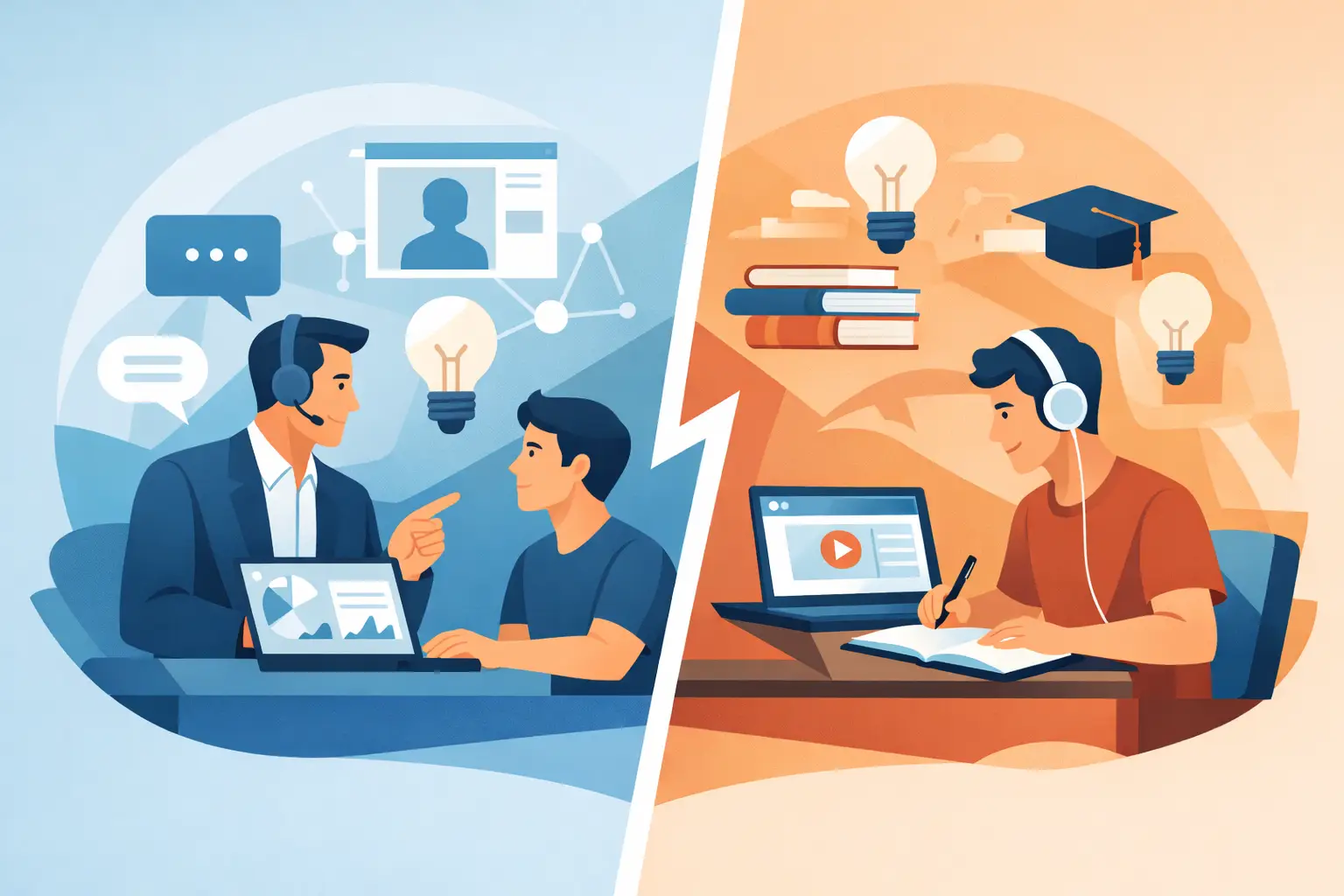
Most people do not quit on building an online business because they are lazy. They quit because they get buried in choices. One video says start with content. Another says paid ads. A third says build a funnel first. When you compare digital business mentorship vs self teaching, that confusion is really what you are measuring: how long you are willing to stay stuck before you get clear.
If you are trying to build something online while working a job, raising kids, or recovering from burnout, this is not a small decision. Your time matters. Your energy matters. And the wrong learning path can cost you far more than money. It can cost you momentum.
Digital business mentorship vs self teaching: what is the real difference?
Self-teaching means you piece together your education on your own. You watch videos, read articles, test tools, join free groups, and try to build a strategy from scattered information. Sometimes that works. Plenty of smart, capable people have taught themselves valuable skills that way.
Mentorship is different. It gives you a framework, feedback, and a shorter path between question and action. Instead of wondering what to do next, you get direction from people who already know what tends to work, what usually fails, and where beginners waste the most time.
That does not mean mentorship guarantees success or that self-teaching is a bad idea. It means the two models ask very different things from you. Self-teaching demands strong judgment before you have much experience. Mentorship reduces the amount of guessing required.
For the audience most likely reading this, that trade-off matters. If you are in your late 30s, 40s, 50s, or beyond, you may not want a hobby in online learning. You want a business you can actually build around real life.
Why self-teaching looks cheaper than it really is
On paper, self-teaching can seem like the smart move. Free content is everywhere. Courses are easy to find. Forums, podcasts, and social media feeds can make it feel like all the information you need is already out there.
The problem is that information is not the same as implementation.
When you teach yourself, you are not just learning marketing, systems, and sales. You are also trying to figure out sequence. What should come first? What can wait? Which advice fits your stage? Which tools are necessary and which are just distractions? Beginners usually do not fail because they lack effort. They fail because they apply the wrong tactic at the wrong time.
That is where the hidden cost shows up. You spend weeks researching instead of launching. You buy tools you do not need. You start one model, abandon it, then start another. You second-guess yourself every time results are slow. None of that appears on a price tag, but it adds up fast.
There is also an emotional cost. Learning alone can wear people down. If you are already balancing work, family, and daily responsibilities, the last thing you need is another project that feels like a maze.
Where mentorship changes the game
Good mentorship does not just give you motivation. It gives you compression. It compresses the learning curve by helping you avoid avoidable mistakes.
That matters in digital business because the beginner phase is where most people lose steam. They overbuild. They overthink. They bounce between strategies. A mentor can cut through that quickly by saying, this is the next move, this is what to ignore, and this is why your current approach is not working.
That kind of clarity is hard to get from generic content online. Free content is often broad because it is made for mass audiences. Your situation is specific. You may have limited hours, limited tech skills, and a real need to create income without turning your life upside down. Personalized guidance helps turn a general idea into a practical plan.
Mentorship also creates accountability. That word gets used too loosely, but here it matters. When nobody is expecting action from you, it becomes very easy to stay in research mode. A mentor, a structured program, or even a strong community can push you to take the next step before doubt talks you out of it.
For many people, that is the difference between wanting an online business and actually building one.
The case for self-teaching still exists
To be fair, self-teaching has real strengths.
If you are naturally disciplined, comfortable with trial and error, and willing to spend a lot of time sorting through conflicting advice, you can absolutely build skills on your own. Some people prefer full control. They like experimenting. They do not mind getting things wrong a few times before finding the right system.
Self-teaching can also be useful if you are still in the exploration phase. Maybe you are not yet sure whether you want to build a content-based business, sell services, learn affiliate marketing, or step into e-commerce. In that early stage, broad self-education can help you understand the landscape.
But there is a catch. Exploration is useful only if it ends. Too many aspiring entrepreneurs stay in learning mode for months because it feels productive. It is safer to consume information than to publish, sell, or make an offer. At some point, self-teaching becomes a shield against action.
That is the moment when structure starts to matter more than freedom.
Digital business mentorship vs self teaching for busy adults
This comparison hits differently when you are not 22 with unlimited time.
If you are a busy adult trying to build a digital business in the margins of your day, speed and simplicity matter more than academic completeness. You do not need ten competing theories about online business. You need a path you can follow after work, between school pickups, or on weekends without feeling like you need a second full-time job just to understand it.
That is why mentorship often makes more sense for career-changers and side-hustle builders. It lowers the decision load. Instead of building the plane while learning how planes work, you step into a framework that has already been tested.
This does not mean you stop thinking for yourself. It means you stop wasting energy reinventing basics.
For people who have been stuck in jobs that drain them, that matters. Momentum is fragile at the start. If the process feels too hard, too technical, or too scattered, most people quietly give up and tell themselves online business just was not for them. In many cases, that is not true. They simply had no roadmap.
What to look for in mentorship if you choose it
Not all mentorship is equal. Some programs sell inspiration and call it strategy. Others drown people in theory without giving them a simple path to implementation.
A strong mentorship environment should offer a few clear things. It should give you a step-by-step process, not vague encouragement. It should help you apply the training to your actual situation. It should include access to people who can answer questions when you get stuck. And it should make progress feel practical, not overwhelming.
Community matters too. Building alone can make every obstacle feel personal. Being around others on the same path helps normalize the learning curve. You stop thinking, maybe I am failing, and start realizing, this is part of the process.
That is one reason platforms like Apex Digital Now appeal to people who want more than information. They want guidance, structure, and support they can actually use.
So which path is right for you?
If you have more time than urgency, enjoy figuring things out alone, and do not mind a slower path, self-teaching can work. If you value independence above speed, it may even be the better fit.
But if you want to build smarter, avoid common mistakes, and move with more confidence, mentorship usually gives you a better shot. That is especially true if your life is already full and your window for focused business building is limited.
There is no trophy for making this harder than it needs to be. Some people wear self-teaching like a badge of honor, but struggle is not a business strategy. The goal is not to prove you can do everything alone. The goal is to build something that works.
If you have been circling the idea of an online business for a while, ask yourself a blunt question: do you need more information, or do you need a clearer path? Your answer will tell you which direction to take. And once you know that, the next step gets a lot simpler.
Ready to take the first step? Register for the free webinar at apexdigitalnow.com and discover how to launch your online business with clarity, confidence, and real support behind you.
—
As with any business, results will vary and cannot be guaranteed.*
Leave a Reply