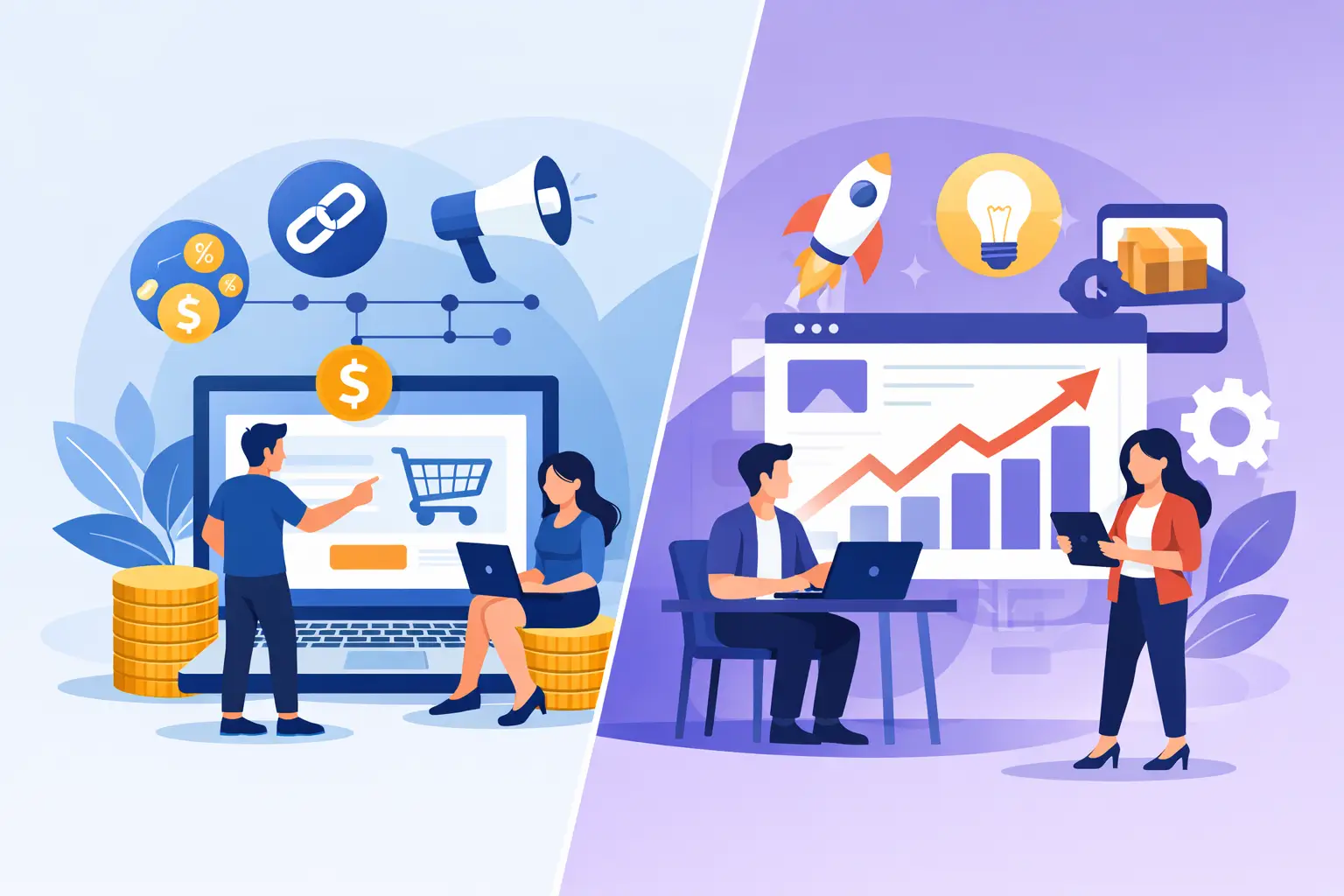
If you’re trying to build income online, the choice between affiliate marketing vs digital business matters more than most people realize. On the surface, both can be run from a laptop, both promise flexibility, and both attract people who are tired of trading all their time for money. But once you get past the hype, they are not the same game.
That difference matters a lot if you’re a working adult, a parent, or someone in mid-career who does not have endless time to waste on trial and error. You do not just need something that sounds good. You need a model that fits real life, gives you room to grow, and does not leave your future sitting in someone else’s hands.
Affiliate marketing vs digital business: what changes?
Affiliate marketing is when you promote someone else’s product or service and earn a commission when a sale happens through your referral. You do not own the product, control the pricing, or manage fulfillment. Your job is to attract attention and convert it into sales.
A digital business is broader and more powerful. It means you are building an online business asset that you control. That could include selling digital products, offering services, running automated funnels, building an email list, creating a brand, or operating a system that generates revenue online. Instead of being only a promoter, you become the owner of the business structure.
That is the real dividing line. Affiliate marketing is a tactic. A digital business is a business model.
Plenty of people start with affiliate marketing because it feels simpler. There is less setup, fewer moving parts, and no product creation. That can make it attractive at the beginning. But simple upfront does not always mean better long term.
Why affiliate marketing appeals to beginners
Let’s be fair about it. Affiliate marketing has real advantages.
The barrier to entry is low. You can get started without creating your own offer, dealing with customer support, or managing delivery. If you are brand new to online income, that can feel less intimidating. You can learn traffic, messaging, and basic online sales skills without having to build every piece from scratch.
It also gives people a way to test the waters. If your main goal is to understand how online selling works, affiliate marketing can teach valuable lessons. You learn quickly that attention is not enough. Offers matter. Positioning matters. Trust matters.
But this is also where many people get stuck. They mistake an easy starting point for a strong long-term path.
Where affiliate marketing gets shaky
The biggest issue with affiliate marketing is control. Or more accurately, the lack of it.
You can put in the work, create content, generate traffic, and build interest, only to have the company change the commission structure, remove the offer, shut down the program, or stop converting well. Your income can drop overnight because of decisions you did not make.
You also usually have limited control over customer relationships. In many cases, you send the lead away and the brand owns the customer from that point forward. That means you did the hard part, but the real asset goes to someone else.
This is why affiliate marketing often feels like rented land. You can earn on it, but you do not own much of what you are building unless you are also building your own audience, your own systems, and your own business around it.
For someone who wants a side income, that may be acceptable. For someone who wants long-term freedom, it can be a weak foundation if it is the only thing they rely on.
What makes a digital business stronger
A digital business gives you more moving parts, but it also gives you more leverage.
When you own the business structure, you have a say in the offer, the customer experience, the branding, the systems, and the growth strategy. You can build an email list. You can create repeat business. You can automate follow-up. You can improve your offer based on real feedback instead of waiting for another company to fix theirs.
That control is not just nice to have. It is what turns online income from a hustle into an asset.
Think about it this way. If you spend a year building traffic for affiliate offers, you may earn commissions, but much of the business value stays with the company you promote. If you spend that same year building a digital business with systems, customer relationships, and a framework you control, you are creating something that can keep paying you beyond a single transaction.
That is a major shift in how your effort compounds.
Affiliate marketing vs digital business for busy adults
If you are 22 and experimenting online with lots of spare time, the trade-offs may not feel that serious. But if you are 42, working full time, raising kids, or trying to replace a paycheck, the wrong model gets expensive fast.
This is where affiliate marketing vs digital business becomes less about internet trends and more about practical life decisions.
Busy adults usually need three things. They need clarity, they need systems, and they need a path that does not reset every time the market changes. Chasing random offers, posting content with no plan, and depending on outside brands is exhausting. It often creates more noise than progress.
A real digital business can still be simple, but simple does not mean scattered. It means having a framework. It means knowing what you sell, who you help, how leads come in, how follow-up happens, and how revenue is generated. That kind of structure matters when your schedule is already full.
The income question nobody should ignore
A lot of marketing online focuses on how fast you can make money. Fair enough. Income matters. But the better question is this: what kind of income are you building?
Affiliate income can be real, but it is often inconsistent unless you have strong traffic systems, a niche advantage, or a highly engaged audience. Many beginners underestimate how much content, testing, and patience it takes to create dependable results.
A digital business can also take time to grow. There is no magic there either. But it gives you more options to increase customer value and stabilize revenue. You can refine your pricing, improve your systems, add offers, and build retention. You are not boxed into one commission percentage and one outside platform.
That does not mean every digital business wins automatically. Poor offers, weak marketing, and lack of support can kill momentum in either model. But if you want income that can mature into something more stable, ownership usually beats dependency.
The real trade-off: speed vs equity
This is where most people need honest guidance.
Affiliate marketing can feel faster to start because the setup is lighter. A digital business can take more intention because you are building something with more depth. So yes, affiliate marketing may give you a quicker entry point. But a digital business gives you a better chance to build equity in what you do.
That equity may not look like stock certificates or a company valuation. It shows up in your audience, your systems, your brand, your customer data, your repeatable process, and your ability to generate revenue without starting from zero every month.
If your only goal is quick commissions, affiliate marketing may be enough. If your goal is control, flexibility, and a business that can grow with you, digital business is the stronger direction.
So which one should you choose?
It depends on what you actually want, not just what sounds easier.
If you want a low-barrier entry into online sales and you are comfortable promoting other people’s offers, affiliate marketing can be a useful starting point. It can teach skills and create some early momentum.
If you want to build something you can shape, improve, and own over time, a digital business is the better move. It gives you more responsibility, yes. It also gives you more upside.
For many people, the smartest path is not choosing one against the other in a rigid way. It is starting with a business mindset from day one. That means even if affiliate marketing is part of the strategy, you still focus on building your own audience, your own systems, and your own brand. You use tactics, but you do not build your future around tactics alone.
That is one reason platforms like Apex Digital Now resonate with people who are serious about changing their situation. They want more than random tips. They want a clear path, real support, and a business framework that fits real life.
You do not need to know everything before you begin. You do need to stop confusing easy to start with smart to build. The best online path is the one that gives you room to earn now and grow later. Choose the model that puts more of your future back in your own hands.
Ready to take the first step? Join the free webinar at apexdigitalnow.com and discover how to launch your online business with clarity, confidence, and real support behind you.
—
As with any business, results will vary and cannot be guaranteed.*
Leave a Reply