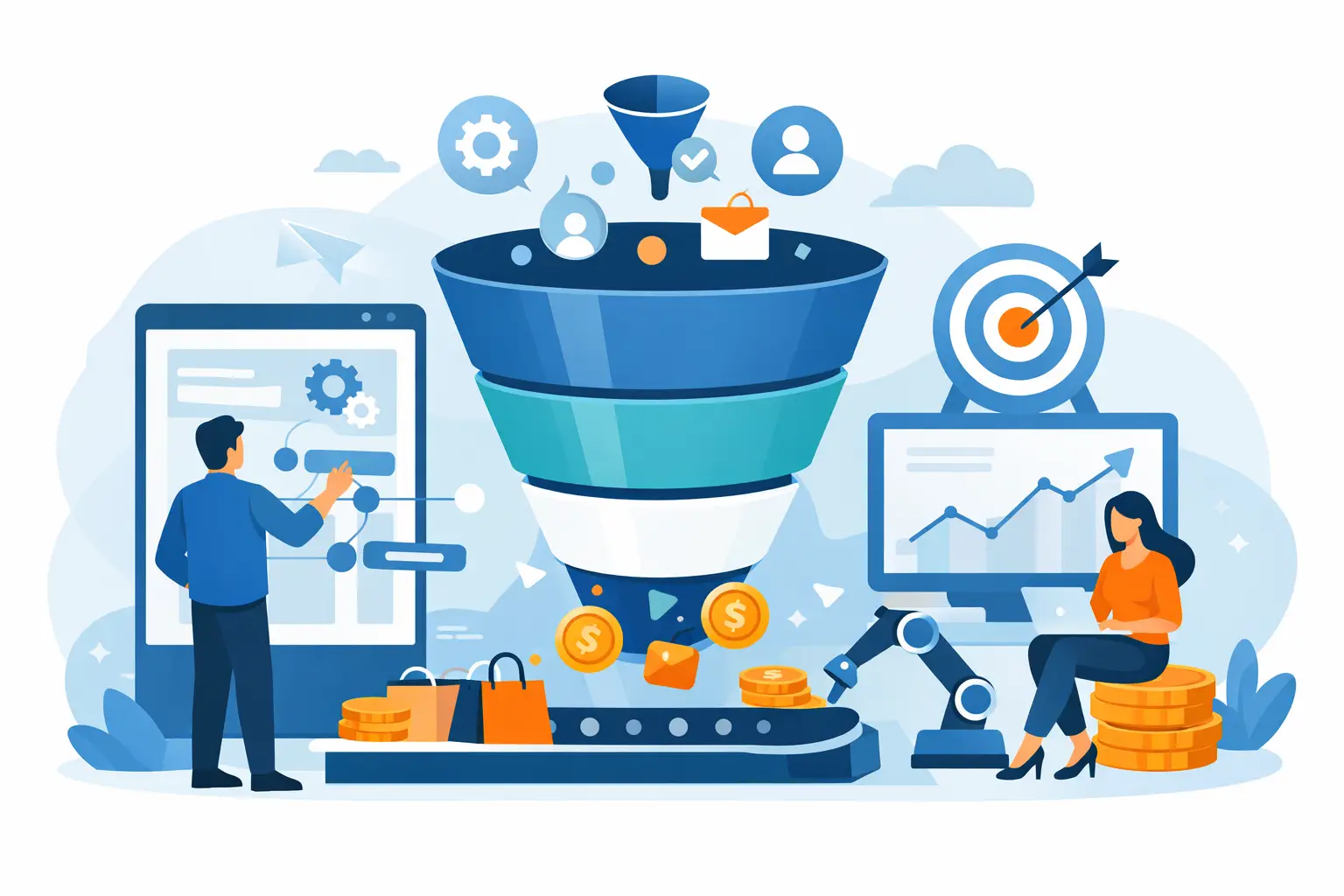
If you’re still trying to sell by posting when you have time, replying to every message manually, and hoping people come back later, you’re making business harder than it needs to be. Learning how to create automated sales funnels is really about building a system that keeps working when you’re at work, with your family, or simply off the clock.
That matters even more if you’re starting an online business later in life, changing careers, or building around a packed schedule. You do not need a complicated setup. You need a clear path that moves the right person from curiosity to trust to action, without you chasing every lead by hand.
What an automated sales funnel actually does
An automated sales funnel is a series of steps that guides a potential customer through your process. First they discover you. Then they give you a way to contact them, usually an email address. After that, they receive follow-up messages, useful information, and a clear offer. If the funnel is built well, the person feels helped, not pushed.
A lot of beginners think a funnel is just a landing page and a few emails. That’s part of it, but the real job of the funnel is bigger. It filters out people who are not a fit, builds trust with the people who are, and creates consistency in your business.
This is why funnels matter so much for people who want more freedom. If every sale depends on your live attention, you have a job with extra steps. If your funnel can educate, qualify, and present your offer automatically, you start building leverage.
How to create automated sales funnels without overcomplicating it
The biggest mistake is starting with software instead of strategy. Tools matter, but they come after the basic decisions. Before you build anything, get clear on three things: who you want to help, what problem they want solved right now, and what action you want them to take next.
If your audience is too broad, your funnel will feel vague. If your offer solves too many problems at once, people will hesitate. If your next step is unclear, leads stall out.
Start simple. Pick one audience, one core problem, and one offer.
For example, if you help busy professionals start an online income stream, your funnel should not talk to college students, full-time influencers, and retired investors all at once. It should speak directly to the person who feels stuck, wants flexibility, and needs a real system instead of random tactics.
Step 1: Build a clear entry point
Every funnel starts with attention. People need a reason to stop and pay attention to what you’re offering. That usually happens through content, ads, social posts, short videos, or a referral.
But attention alone is not enough. You need an entry point that gives them a simple next step. That might be a free guide, a checklist, a webinar, a training, or a short quiz. The format matters less than the relevance. Your lead magnet should solve a small but urgent problem and naturally connect to your paid offer.
This is where many funnels break. They offer something generic like “10 tips for success” and wonder why the leads never buy. A good lead magnet attracts people who are likely to want the next step. A bad one collects email addresses from people who were only mildly curious.
Step 2: Create a landing page that does one job
Your landing page should not try to explain your whole business. Its job is to get the visitor to take one action. That usually means entering their email and requesting the free resource or registering for the training.
Keep the message tight. Lead with the problem, make the result clear, and remove distractions. You do not need fancy design. You need clarity.
A strong landing page usually answers four questions fast: What is this, who is it for, what will I get, and what do I do next? If a visitor has to work to figure that out, conversions drop.
Step 3: Set up email follow-up that sounds human
Once someone joins your funnel, the follow-up sequence does the heavy lifting. This is where trust gets built.
Most people will not buy the first time they see an offer. That is normal. They may be busy, skeptical, distracted, or simply not ready. Your emails should meet them there.
Start with a welcome email that delivers what you promised. Then send a short sequence that helps them understand the problem more clearly, shows what is possible, handles common objections, and introduces your offer naturally.
Do not write like a corporation. Write like a real person who understands the struggle and has a way through it. For this audience, that matters. People who are exploring a new business model often carry doubt. They are not just buying information. They are buying confidence, direction, and a process they can trust.
Step 4: Make the offer simple to say yes to
A funnel fails when the offer is confusing, mismatched, or too big for the stage of awareness the lead is in.
If someone just met you, asking them to commit to a high-ticket program with little context is a stretch. Sometimes it works, especially with a webinar or strong appointment funnel, but often a smaller commitment works better first. It depends on your market, your price point, and how much trust your funnel builds before the ask.
Your offer page or sales presentation should make the outcome clear, explain how it works, and show why this solution is different from trying to figure it out alone. Be direct. Do not pile on hype. People can feel when they are being pushed.
If your business model includes mentorship, structure, and done-with-you guidance, say that plainly. For many beginners, support is not a bonus. It’s the deciding factor.
Where automation helps – and where it doesn’t
Automation is powerful, but it is not magic. It can send emails, segment leads, trigger reminders, book calls, and follow up consistently. That saves time and cuts down on leads slipping through the cracks.
What automation cannot do is fix weak messaging, a poor offer, or a lack of trust. If nobody wants the thing you’re selling, more automation just helps you fail faster.
This is why testing matters. Watch where people drop off. Are they clicking the ad but not opting in? Your landing page may be weak. Are they opting in but not opening emails? Your subject lines or audience targeting may be off. Are they reading but not buying? The offer or timing might need work.
Treat your funnel like a working system, not a one-time project. Small improvements compound.
The basic tech stack for automated sales funnels
You do not need a dozen tools. In most cases, you need a page builder, an email platform, a checkout system if you’re selling directly, and analytics so you can see what is happening.
Some all-in-one platforms combine most of this. Others work better as separate tools. There is no perfect setup for everyone. If you’re new, simpler is usually better. The best system is the one you will actually use consistently.
This is one reason mentorship and proven frameworks matter. Too many people waste months comparing software when the real issue is they do not have a clear funnel strategy. A platform like Apex Digital Now appeals to that reality because many beginners do better with a model they can plug into and learn from instead of building every moving part from scratch.
Common mistakes people make when learning how to create automated sales funnels
The first mistake is trying to automate before they understand their customer. The second is adding too many steps. The third is quitting too early because the first version does not convert perfectly.
A simple funnel with a relevant lead magnet, a clear landing page, a thoughtful email sequence, and one strong offer can outperform a complicated funnel every time.
Another mistake is sounding too polished. That may seem strange, but for this kind of audience, overly slick marketing can raise red flags. Real people want clarity. They want proof. They want to know whether this can fit into real life, not just a sales pitch.
Start with one funnel and make it work
You do not need five funnels. You need one funnel that solves one problem for one type of person.
That is how momentum starts. Build the first version, launch it, watch the numbers, and improve what is not working. Once that system is converting, then you can expand.
The people who win with online business are usually not the ones doing the most. They are the ones doing the right things consistently. A smart funnel gives you that advantage. It turns scattered effort into a repeatable process, and that can change a lot more than your sales.
Watch the free webinar at apexdigitalnow.com and see exactly how the model works — no hype, no pressure, just the truth about what is possible for you.
—
As with any business, results will vary and cannot be guaranteed.*
Leave a Reply